- The 3:30 PM meltdown happens because kids have held it together at school all day—offer food and 20 minutes of decompression before homework or chores.
- The American Academy of Pediatrics (AAP) asks whether screens are crowding out sleep, play, and family time. The practical answer is to make offline play easier to grab than a tablet, instead of relying on bans alone.
- Match the activity to your child's actual after-school state—high-energy physical release, quiet solo wind-down, or hands-on kitchen and maker projects.
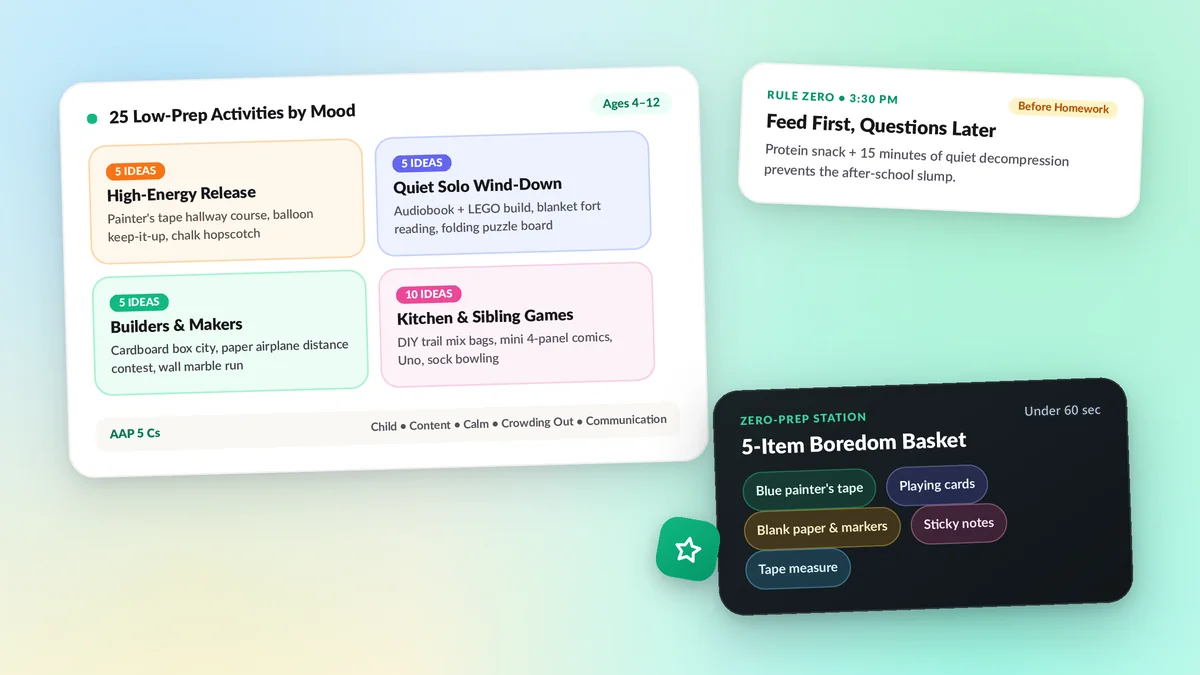
- Keep one stocked 'Boredom Basket' on a low shelf so kids can launch an activity in under 60 seconds without asking you to prep supplies.
Why 3:30 PM Feels Like a Minefield (And Why Pinterest Crafts Fail)
At 3:45 PM on a Tuesday, nobody wants to dye dry macaroni in five colors or glue 40 popsicle sticks into a birdhouse. Your child is hungry and mentally wrung out, and you still have emails to answer and dinner to start.
Most screen-free activity lists forget the single most important variable of real family life: prep friction. If an offline idea takes 15 minutes for an adult to set up and 20 minutes to scrub off the dining table, the tablet wins every single time.
The easiest way to cut after-school screen battles is to crowd offline play in instead of only banning screens: feed kids first, then stock low-prep, energy-matched activities they can start in under 60 seconds without adult setup. It is the practical side of the American Academy of Pediatrics (AAP) question of whether media is crowding out play, sleep, and family time.
Below are 25 low-prep activities organized by what your child actually needs after the school bell—burning off pent-up energy, zoning out quietly, or creating something hands-on—plus the exact supplies for a five-item Boredom Basket.
Rule Zero: Feed First, Ask Questions Later
Many elementary school lunch periods happen as early as 10:45 AM or 11:15 AM. By the time your child walks through the door at 3:30 PM, they have gone four hours without real calories while following classroom rules all day.
Put a protein-and-carb snack directly on the counter before asking "How was school?"—apple slices with peanut butter, string cheese and pretzels, or hummus and pita chips. Give them 15 quiet minutes to eat and decompress. You will be stunned how many attitude problems disappear once blood sugar rebounds.
The 25 Low-Prep Activities Sorted by After-School Energy
Do not pick randomly off a giant list. Glance at your child's body language first: a kid bouncing off the couch cushions needs heavy physical movement, while a slumped, quiet kid needs low-demand solo decompression.
| After-School Mood | Best Ages | 5-Minute-or-Less Activity Ideas |
|---|---|---|
| High Energy (Need to Burn Steam) | Ages 4–10 | 1. Painter's tape hallway obstacle course; 2. Balloon keep-it-up (no hands allowed); 3. Driveway chalk four-square or hopscotch; 4. Backyard/living-room timer scavenger hunt; 5. Freeze dance to a 3-song playlist |
| Quiet Solo Wind-Down | Ages 4–12 | 6. Audiobook + coloring or LEGO build; 7. Graphic novel hammock/blanket fort; 8. 100-to-500 piece puzzle kept on a folding board; 9. Hidden-picture books or maze pads; 10. Window-watching sketch notebook |
| Hands-On Builders & Makers | Ages 5–12 | 11. Cardboard shipping-box city or pet house; 12. Paper airplane distance tournament (measure with a tape measure); 13. Recycled-material marble run taped to a wall; 14. Air-dry clay or homemade playdough figures; 15. Origami animals from a basic step-by-step book |
| Kitchen & Real-Life Helpers | Ages 6–12 | 16. Assemble DIY trail mix snack bags for the week; 17. Wash and tear salad greens or snap green beans for dinner; 18. Bake a 3-ingredient mug snack or banana-oat muffins; 19. Design tonight's paper dinner menu with funny dish names; 20. Sort and pair family socks for a timed personal record |
| Older Kids & Sibling Games | Ages 7–12 | 21. Uno, Sleeping Queens, or War with a standard card deck; 22. Stop-motion storyboard drawn on sticky-note flipbooks; 23. Create a mini comic strip (4 panels on folded printer paper); 24. Indoor bowling with empty plastic bottles and a rolled sock; 25. Write and mail a real postcard to a grandparent or cousin |
Why 'Crowding In' Beats Strict Screen Bans
The American Academy of Pediatrics (AAP) encourages parents to look at media through the 5 Cs—Child, Content, Calm, Crowding out, and Communication—rather than obsessing over a single rigid minute count.
Think about the fourth C: Crowding out. Screens become a problem mainly when autoplay and scrolling crowd out outdoor play, hands-on boredom, family meals, and sleep. Instead of turning screens into forbidden fruit, protect two clear offline anchors every weekday: keep the dinner table device-free and park all screens outside bedrooms at least one hour before bedtime. Fill the afternoon gap with easy, visible alternatives and the friction drops dramatically.
Build a 5-Item Boredom Basket Once (Use It All School Year)
When kids announce "I'm bored," they rarely want an adult to entertain them—they just cannot picture a starting point. Keep one open bin in the living room stocked with five cheap, endlessly reusable triggers: a roll of blue painter's tape, a deck of playing cards, a pad of blank printer paper with washable markers, sticky notes, and a tape measure.
Rotate just one item every Sunday night (swap in modeling clay, dice, or a fresh comic book) so the basket always feels slightly new. Paired with our Calm 30-Minute School Morning Routine, you get smooth transitions on both ends of the school day.
Interactive Printable Checklist